Friday, August 3, 2007

2008 Chrysler minivans let middle-sitters
face rear-sitters

Aiming to lure customers back from SUVs and "crossover" vehicles, 2008 Chrysler and Dodge minivans are packed with new technology and a seating arrangement that lets families hang out around a virtual "kitchen table" on the road.

The centerpiece of the redesigned 2008 Dodge Caravan and Chrysler Town & Country is a second-row seat that can spin 180 degrees to face backward. Nicknamed "Swivel n' Go" after the carmaker's popular "Stow n' Go" flat-fold seats, the new seats create space for a one-legged table that lets passengers eat, do homework or pile things up the way they would in the house.

But the minivans, which hit showrooms later this month, are crammed with an array of new features that smooth away any remnant of the old fuddy-duddy mom-mobile.

Pinpointed overhead LEDs provide bright, targeted illumination more akin to airplane reading lights than the old halo lamps. A convex "conversation mirror" drops down above the rearview to give the driver a full view of what's going on in back, while the middle console slides nearly 2 feet backward and forward, allowing people riding in the front seats to ferry items — snacks, headphones, whatever — to the rear without blind backward tosses or uncomfortable twisting.

The minivans also boast a unique multiple-output entertainment system designed to eliminate the forced compromises of earlier days by channeling different options to passengers riding in separate parts of the van. That means the youngest kids in the middle can watch Nickelodeon on satellite while their parents get Sirius radio in the front and older siblings scan music on a built-in 20-gigabyte hard drive or watch R-rated DVDs in the back seat.

Meanwhile, the original Stow n' Go technology has been upgraded so that the third-row seats fold down automatically into a hatch with the push of a button. They can also be somersaulted backward to create cushioned seating for tailgating parties.

The new models are boxier and more imposing than their predecessors, with a new suspension that gives a confident ride. Gone is the rounded, pod-like exterior of earlier models; banished is the wobbly "minivan" feel on the road

The minivan's designers employ words such as "tailored" and "rich" to describe the Town & Country models, targeted at wealthier parents or at new retirees looking for an upgraded way to cart around grandkids. The Dodge equivalents, meanwhile, are "sinister" — not a word usually associated with minivans. "It's tough, it's angry, it's in your face," according to chief designer Mark Trostle, who said the new Caravans echo the look of the successful Magnum car.

Chrysler, in the midst of its corporate breakup from DaimlerChrysler and sale to private equity firm Cerberus, is depending on the new line to help it stay ahead of encroaching competition in the minivan market from Honda and Toyota, especially now that General Motors and Ford have halted minivan production.

Minivan sales rose quickly when Chrysler introduced them in 1983 as a 1984 model. Annual sales crossed 900,000 in 1990 and peaked at 1.37 million in 2000. But since then, the vehicle has started to fall out of favor, especially with the introduction of car-based crossovers that can carry as many people.

Sales dropped to 970,708 last year, and through July, 477,662 were sold, a 22 percent decrease from the first seven months of 2006.

Chrysler says it believes the new models provide a level of convenience and value that consumers won't find in sport-utility vehicles or in newer crossovers. "There is no substitute for a minivan," said Rick Kukucka, a marketing director for the company.

Still, Chrysler Group isn't taking chances. In July, the company announced it would offer lifetime repairs on the engines, transmissions and drive systems of most cars sold in the US. (info from The Associated Press)

Thursday, August 2, 2007

Panasonic wireless phone system
installs in a few minutes.

Panasonic’s KX-TG4500 5.8GHz multi-handset wireless phone system combines the advantages of a business-style telephone system with convenience, mobility and easy installation.

It is the replacement for the extremely popular KX-TG4000 that made a big change in the residential and small business telecommunications business a few years back. Suddenly, professional installers with expensive trucks filled with cable, drills, snakes and staplers were simply not needed. Lots of phone system dealers were really pissed off at Panasonic, but consumers and business-owners were smiling and saving.

The original KX-TG4000 worked in the 2.4GHz frequency band. The new 5.8GHz model is less likely to cause interference with, or be interfered by, wireless computer networks. It also has more features, is more reliable, and costs less (under $450 for the first two phones, $99 for each additional phone).

It provides full phone system functions, such as intercom and voice mail, but doesn’t require the complicated wiring or central control unit needed for a conventional phone system. No special tools or training are needed for installation -- it's pretty much plug-and-play. Just connect the phone lines to the master base unit, plug in the AC charging cradle for each handset, set the intercom numbers, and the system is ready for use.

The KX-TG4500 connects as many as four phone lines. You can record multiple outgoing messages, and select which message goes with which line. If you have a business at home, for example, callers to one line would hear "Thank you for calling the Adams family..." but callers to your other line(s) would hear "Thank you for calling Adams Consulting Services..."

Up to eight wireless handsets can be used with each system, with full functions available at each handset.

The KX-TG4500 is designed to handle your messaging needs when you’re not available. The base incorporates a digital voice mail system with 100-minute capacity, plus auto attendant, so callers can "Press one-and-pound for sales, press two-and-pound for tech support" or "Press one-and-pound for Sally, press two-and-pound for Steve."

The system provides separate voice mailboxes and individual greetings for each handset in the system, plus a "general delivery" mailbox. And, unlike some messaging systems that allow only one user’s voice mail to be accessed at a time, the KX-TG4500 enables simultaneous voice mail operation from each handset regardless of the phone line in use.

Other messaging features include remote message and mailbox access from any handset, full voice prompts, and time and date stamps for each message recorded.

If you have Caller ID, even with Call Waiting service from your phone company, you can know who’s calling before speaking -- just glance at the illuminated three-line display on a handset or the base. The three-line LCD display will show each caller’s complete information without additional scrolling.

Backlighting on the LCD greatly aids visibility, especially in low light. Caller ID memory (viewable via the base or handset display) is for later review with instant callback capability. The base unit can store up to 100 callers’ names and numbers and each handset has memory capacity for an additional 30 names and numbers.

Either base or handset LCD’s also show “line in use,” message waiting and other icons for system status. The KX-TG4500 can also save your most-frequently dialed phone numbers in their alphabetical directory. The phone systems each have a 50-Station phone directory with dialer on the base, with room for an additional 50 names and telephone numbers on each handset.

A navigator key on each handset provides easy access to the Phone Directory/Dialer and Caller ID Memory. This key can also be used to set the handset volume or ringer loudness, or for programming and other functions.

Taking advantage of the ultra-clear 5.8GHz frequency band and Frequency Hopping Spread Spectrum (FHSS) Digital Operation, these new multi-handset telephone systems “spread” their signal over many frequencies each second, helping to assure private conversation.

The KX-TG4500 lets you call any wireless handset from the base unit or “page” them all at once. Three-way conferencing capability lets you link two handsets with an outside call or two outside calls with an internal handset. Digital duplex speakerphones with eight-step volume control, located on the base of each model, is also included. This digital circuitry helps reduce the echo and dropout commonly found in conventional speakerphones, resulting in crystal-clear, hands-free conversations.

The basic package includes a wired "base" phone plus one wireless handset. You can easily and economically add up to seven more wireless handsets.

Each handset is powered by a high-capacity Nickel Metal Hydride (NiMH) battery, which offers twice the capacity of standard Nickel Cadmium rechargeable batteries, and recharges in the included AC-powered charging stand. Talk time is up to 8 hours, and standby time up to 96 hours.

Additionally a lighted keypad on each handset provides convenient dialing even in dimly lit situations and a headset jack allows connection to headsets equipped with a 2.5mm plug. Other features on each handset include belt clip, three-level handset volume control, an adjustable ringer (Off/Low/High) with four selectable patterns, Call Transfer, Incoming Call Tone, Any Key Answer, Hold, Flash, Pause, Redial and Tone/Pulse Dialing. Base-to-handset range is about 300 feet. Wall-penetration is excellent.

You can even connect one or more door intercom speakers, so you can speak to the Fedex driver while you're out in the backyard or cleaning your attic.

CLICK to order at PanasonicTel.com

Wednesday, August 1, 2007

Throw this hash in the trash

Corned beef hash has long been a special breakfast treat. As a kid, my mother occasionally burned some of Libby's hash and scrambled eggs for me; and later, as an independent adult, I switched to the Broadcast brand when Libby's apparently disappeared.

Since I got married, I've seldom had hash at home, because my beloved wife hates the smell, and the left-over reminds her of canned dog food (which our beloved dog never eats).

I sometimes order hash in diners, but half the time it has some weird flavor that I can't stand, and the other half, it's too mushy, even when I order "crisp".

Anyway, last week I was in a local food market, and felt the urge to indulge myself in some comfort food. I explored the shelves in search of the elusive Libby's, or even an acceptable substitute can of Broadcast, but the store had none.

After asking for help from three different people (one of whom had never heard of corned beef hash), I was directed to the bottom shelf of the far end of Aisle Five -- where they keep Spam and Manwich and Dinty Moore's beef stew and other gastronomic delights of ill repute, and I spied several cans of Hormel 50% reduced fat homestyle corned beef hash.

Wow. I was excited. Imagine getting something that I love, that might actually be relatively harmless to my body!

I grabbed a couple of cans, raced to the checkout, and drove home in eager anticipation.

Alas, my excitement and anticipation were unjustified and unfulfilled. Even though I grilled the hash to absolute perfection, it had absolutely no flavor. It was like eating a glob of potato and cardboard with salt.

After I trashed my hash, I read the label on the surviving can. It said "water added to reduce fat." Yeah, the flavor in corned beef hash comes from its fat; and water is not nearly as flavorful as fat.

Even with its diluted formula, a serving of this tasteless poison provides 25% of my daily recommended dose of saturated fat, 20% of my cholesterol, and 45% of my sodium! I'm amazed that something that's this harmful, could taste so bad.

Fortunately, there's other bad stuff that tastes good. For lunch, I got some pizza and an ice cream soda to take my mind off Hormel.

Tuesday, July 31, 2007

New & improved Hi-Def camcorders
coming from Panasonic

Panasonic has announced its second generation models of its AVCHD-based high-definition camcorders, boosting the resolution to 1920 by 1080. The HDC-SD5 and SX5 are both 3CCD models with 30 percent more pixels than the prior 1440 by 1080 AVCHD models they replace (the SD1 and DX1).

The camcorders, due in September, feature Leica lenses and 10x optical zooms with a new optical image stabilization system that the company says offers eight times the stabilization compensation of the previous system. Both models are EZ Sync compatible and feature a new wide-angle 2.7-inch LCD screen with a two-level power function to boost brightness for outdoor viewing.

The HDC-SD5, for a suggested $999 retail price, records video to SDHC memory cards. It features a new USB Host function that lets the camcorder connect to the company’s new DVD burner (the VW-BN1 for a suggested $199) to burn HD video to traditional DVDs for playback on select Blu-ray Disc players. Panasonic says it is the world's smallest palm-style 3CCD full-HD camcorder, measuring just 2.6 x 2.6 x 5.3 inches.

The $899-suggested HDC-SX5 is a hybrid model that records to both SDHC and standard DVD discs. According to Panasonic, an 8GB SDHC card can store up to 180 minutes of video while a 3-inch DVD-R dual layer can hold an hour of HD video in HE mode (6MBps) for a total of 240 minutes of HD footage. It can transfer video from an SDHC card to a DVD internally or record standard-definition video to DVD disc in MPEG2 format.

To complement both models, Panasonic also launched an 8GB SDHC card with a Class 6 speed rating, to sell for about $159.

Both camcorders have a several new features, including a new processing engine to reduce power consumption, and prerecording, which captures three seconds worth of video to buffer memory prior to the start of recording. A new intelligent contrast control adjusts contrast by measuring ambient light in a scene.

The camcorders will be packaged with software for editing HD video and saving it in either AVCHD format or DVD-video format. (info from Panasonic and TWICE)
THIS IS A PREVIEW, NOT A REVIEW.

Monday, July 30, 2007

D'oh..n't miss Simpson's movie

90 minutes of giant-screen Simpsons is more than three times as good as 30 minutes of TV-size Simpsons. The movie is creative, hilarious, relevent, irreverent, surprising, even exciting...everything you'd expect.

Sure, it would have been nice to have more of Burns/Smithers, Apu, Mrs. Krabappel, Grampa Abe, Principal Skinner, Patty and Selma et al...but the list of potential players was HUGE, and they only had four years to put this together. OTOH, we do get to see Bart's weenie, and hear Maggie speak, and there's a great Itchy & Scratchy mini-movie.

After previous attempts to create a film version of The Simpsons had failed due to script length and lack of staff, production began in 2001. Numerous plot ideas were conceived by the writers, with series originator Matt Groening's being developed into the film.

The script was said to have been re-written 100 times, continuing even after animation had begun. Many hours of finished material was cut, including cameos from Minnie Driver, Erin Brockovich and Kelsey Grammer. Tie-in promotions were made with 7-Eleven, which transformed select stores into Kwik-E-Marts, and other companies such as Burger King. The film premiered in Springfield, Vermont, which won the right to hold it through a competition.

The movie starts with Green Day performing at Lake Springfield, where they fail to get the audience interested in saving the environment. They are killed when the pollution in the lake eats away at their vessel, causing it to sink. At the funeral, Grampa Abe has a vision of a great catastrophe to come, but only Marge listens. Lisa and an Irish boy named Colin hold a seminar entitled "An Irritating Truth", which convinces the town to clean up the lake. Meanwhile, Homer dares Bart to skateboard nude to Krusty Burger, but Bart is caught by Chief Wiggum. Ned Flanders comforts Bart after being humiliated, but Homer ignores him and adopts a pig, who is allowed to leave foot prints on the ceiling in a "Spider-Pig" game.

Homer keeps the pig's "crap" in an overflowing silo, which horrifies Marge, who tells Homer to dispose of it safely. While waiting in a line at the dump, Homer decides on a quicker means of disposal and dumps the silo into the lake, causing it to become heavily polluted. Nearby, Flanders and Bart bond during a hike and discover a many-eyed mutated squirrel, which is captured by the EPA. Russ Cargill, head of the EPA, tells President Schwarzenegger that Springfield is extremely polluted and the government must take drastic action. As a result, the EPA places Springfield under a giant clear dome.

The police discover Homer's silo in the lake, and an angry mob approaches the Simpsons' home and torches it, in a scene from Frankenstein. The family escapes through a sinkhole that goes under the edge of the dome, and flees to Alaska (without the pig) in a truck won in a motorcycle-riding contest, to live in a chalet, with no visible means of support.

Seeing the dome begin to crack and realizing the inevitable escape of the people of Springfield, Russ Cargill manipulates the President into deciding to destroy the town and create a huge hole.

While enjoying life in Alaska, the Simpsons see an advertisement presented by Tom Hanks, promoting a new Grand Canyon, to be located where Springfield is. Marge and the kids decide that they must save Springfield, but Homer refuses to help the town that tried to kill him.

Marge and the kids abandon him and leave for Springfield, via train. After a visit with a mysterious Inuit shaman with huge breasts, Homer has a vision and reaches an epiphany: he must save Springfield and his family.

Meanwhile, Marge, Lisa, Maggie, and Bart are captured by Cargill and returned to Springfield. Cargill tells Springfield's people that the town will be destroyed. A helicopter arrives and opens a hole at the top of the dome, lowering a bomb. Homer climbs the dome and descends, knocking the escaping town people and bomb off the rope. Homer notices a motorcycle, grabs Bart, and cycles up the side of the dome. Bart throws the bomb through the hole, detonating it and shattering the dome. The town praises Homer, who rides off with Marge on the motorbike into the sunset. The film ends with everyone restoring Springfield, including the Simpsons' house, back to the way things were.

There are some extremely funny scenes. One in particular, when doom is apparent, shows people streaming from the church into Moe's tavern, at the same time that people are running from the tavern into the church. Another, when the family is on the lam, has Bart deface a wanted poster showing the Simpsons; and then people who look like the distorted images on the poster are arrested.

Don't leave until the very end, and -- if you're a fan -- figure to see it at least twice. CLICK for more. (some info from Wikipedia)

Thursday, July 26, 2007

TIME OUT

I'm taking a few days off. I'll be back next week.

Wednesday, July 25, 2007

Outdoor phone housing

If your al fresco communications needs are met by a cordless or cellular phone, read no further.

But if you have a need for a permanently installed outdoor phone at a tennis court, swimming pool, guard shack, security gate, parking lot, outdoor stage, camp ground, airport, amusement park, mobile home park, etc., you're in the right place.

This enclosure is ideally suited for outdoor use, or any environment where a protective housing is required.

It's constructed of durable glass-reinforced polyester, resistant to weather and corrosive chemicals. The hinged door provides a positive seal when the door is closed and securely latched. Color is basic neutral gray. It has sturdy mounting flanges for easy attachment to a flat or curved surface, and has a standard modular wall jack to accommodate most wall phones.

It's also available with an optional locking door, if you're concerned that your phone may take a walk. CLICK to order from RedHotPhones.com.

Tuesday, July 24, 2007

Much-less-expensive Hi-Def TiVo coming

When TiVo introduced a high-definition digital video recorder last fall, they touted the long-awaited set-top box as a best-in-class product with a price tag to match.

But in a market already filled with lower-priced offerings from cable companies and other rivals, TiVo’s $800 Series3 HD Digital Media Recorder had a hard time winning customers, even as consumers opened their wallets for high-definition televisions.

Some dealers sell it for about $600, and TiVo offered a $200 rebate last month. (That's when I bought two to replace crappy Cablevision HD DVRs.)

This year, TiVo hopes to widen its hi-def appeal with a more affordable model: the TiVo HD DVR for $299.99. The company will begin taking pre-orders for it on its Website today, and units are expected to hit retail outlets by early August.

The TiVo HD DVR has many of the same technical features as its higher-priced Series3 cousin. It has two tuners, so you can record two different shows in HD at the same time while watching a third, prerecorded show. It also has two built-in slots for CableCARD, allowing access digital programming without a cable box.

The new model will have a smaller hard drive — 160 gigabytes instead of 250 GB, storing about 20 hours of high-definition programming or up to 180 hours of standard programming. It has a simpler remote control, less deluxe cosmetics, and unlike the $800 box, is not THX certified. (some info from The Associated Press)

Monday, July 23, 2007

Save big bucks on terrorists' tools

I love the Leatherman Micra miniature multi-tool (CLICK for review from March '07). I keep one on my keychain, and seldom go anywhere without it.

Unfortunately, on a recent flight to Texas, I forgot to remove it from my keychain, and forfeited it a Transportation Security Agency enforcer at the airport.

I wanted to replace it as soon as I got home, but was disappointed to find that my nearby Costco no longer sold the Micra. On a whim, I checked eBay, and found that I could get one for $30 brand new, or get five of them for $25, not new. Even larger quantities were available for as little as two bucks each.

Apparently, lots of Micras, box cutters, Leathermen, Swiss Army Knives, chain saws and assorted other potential instruments of destruction are confiscated from passengers and sold by the government, and then re-sold to the public at a small fraction of their original prices.

The five I bought were all in excellent conditions, but I gave them an alcohol wipe-down in an effort to neutralize the previous owners' biological samples before using the tweezer or finger nail cleaner on my own body.

If you get one, scratch your initials on it. If the Feds grab it, you may get lucky and find it in a batch you buy through eBay.

Friday, July 20, 2007

Want world's fasted web access?
Go to the land of Smörgåsbord and SAAB

She is a latecomer to the information superhighway, but 75-year-old Sigbritt Lothberg is now cruising the Internet with a dizzying speed. Lothberg's 40 gigabits-per-second fiber-optic connection in Karlstad, Sweden is believed to be the fastest residential uplink in the world.

In less than 2 seconds, Lothberg can download a full-length movie on her home computer - many thousand times faster than most residential connections. The speed is reached using a new modulation technique that allows the sending of data between two routers placed up to 1,240 miles apart, without any transponders in between.

Peter Lothberg, who is a networking expert, said he wanted to demonstrate the new technology while providing a computer link for his mother. "She's a brand-new Internet user," Lothberg said. "She didn't even have a computer before."

His mother isn't exactly making the most of her high-speed connection. She only uses it to read online newspapers. (info from The Associated Press)

Thursday, July 19, 2007

$200 Sony camcorder is aimed at web use

Courting the growing number of YouTubers and other video Website fans, Sony will soon debut its GC1 "Net-Sharing Cam," a flash-based video recorder with built-in software for uploading to video sites and blogs. The pocket-size camcorder measures 1.2 by 4.1 by 2.3 inches and weighs about 5 ounces. It should be available in September at about $200.

The GC1 won’t carry Sony’s traditional Handycam brand to differentiate it from the traditional camcorder category. The Memory Stick-based device records MPEG-4 video at VGA resolution at 30 fps and also takes 5-megapixel still images. A dedicated “sharemark” button lets users tag video for uploading after they’ve been transferred to a computer.

The camcorder is loaded with PMP Portable software, which runs when the GC1 is connected to a computer. Tagged videos are then automatically uploaded to the Web and users can program the software to upload videos to multiple video sites or personal blogs.

The camera will also ship with Picture Motion Browser desktop software for video editing and additional software for turning the Net-sharing Cam into a Web camera. It has a 2.4-inch color LCD, built-in flash, fixed focal length lens with a 4x digital zoom and a rechargeable Lithium Ion battery for about 90 minutes of recording. (info from TWICE) (This is a preview, not a review)

Wednesday, July 18, 2007

New Blackberry works on Wi-Fi, has GPS

Research In Motion yesterday announced the BlackBerry 8820 smartphone, which provides both cellular and Wi-Fi connectivity and built-in GPS, plus RIM's thinnest smartphone design with a full QWERTY keyboard.

It has a large and bright 320 by 240 display, trackball navigation, media player enhancements, and a microSD / microSDHC (microSD High Capacity) expandable memory slot that can support current and future generations of microSD memory cards up to 32GB.

The BlackBerry 8820 is the first dual-mode BlackBerry handset, combining EDGE/GPRS/GSM cellular and Wi-Fi connectivity for data access and voice support through UMA (unlicensed mobile access) for fixed-mobile convergence (FMC) service offerings from various wireless carriers around the world with the added ability to stay connected via Wi-Fi at home, through hotspots and corporate campuses.

To meet various security requirements, the BlackBerry 8820 is compliant with Wi-Fi security protocols including WEP (Wireless Equivalency Protocol), WPA (Wi-Fi Protected Access) and WPA2, as well as Cisco Compatible Extensions for simple, secure connectivity with Cisco wireless solutions. For enterprises that require Wi-Fi users to access the corporate network through a VPN (Virtual Private Network), the BlackBerry 8820 includes IPSec-based software that supports the most commonly deployed VPN gateways from vendors including Cisco, Check Point and others.

The BlackBerry 8820 also supports UMA, enabling wireless carriers to offer a fixed-mobile convergence service for both business and home use. With a UMA solution in place, the BlackBerry 8820 can also seamlessly switch voice calls between a wireless carrier's cellular network and a Wi-Fi network.

The BlackBerry 8820 is a quad-band GSM/GPRS and EDGE-enabled smartphone that provides global wireless voice and data capabilities with best-in-class performance. The BlackBerry 8820 features include:

• World Class Phone – The BlackBerry 8820 is a world-class mobile phone with advanced noise cancellation for enhanced audio performance and easy-to-use phone features including Speaker Independent Voice Recognition for Voice Activated Dialing (VAD), smart dialing, conference calling, speed dialing and call forwarding, as well as dedicated "send", "end" and "mute" keys. It features a high quality, low-distortion speakerphone and Bluetooth® 2.0 for use with hands-free headsets, car kits and other Bluetooth peripherals. Support for polyphonic, mp3 and MIDI ringtones is also included.

• Built-in GPS – Through its built-in GPS, the BlackBerry 8820 can pinpoint its location and provide "out-of-the-box" support for a wide variety of location-based applications and services, including BlackBerry® Maps.

• microSD / microSDHC Expansion Memory – The BlackBerry 8820 includes a microSD expansion memory slot that can support both microSD (up to 2GB) and microSDHC (4GB to 32GB) memory cards. 4GB memory cards are available today, and 8GB cards are expected to be available later this year.

• BlackBerry Services – The BlackBerry 8820 can operate with BlackBerry Internet Service, giving users the ability to manage up to 10 supported personal and corporate email accounts, as well as BlackBerry Enterprise Server, enabling advanced security and IT administration features within IBM® Lotus® Domino®, Microsoft® Exchange and Novell® GroupWise® environments.

• Application Support – The BlackBerry wireless platform gives customers the capability to deploy a variety of applications. Thousands of applications and business solutions from third party software providers can further extend the BlackBerry platform to support business needs such as CRM, sales force automation, field services, business intelligence, supply chain management and continuity of operations, as well as a broad range of industry-specific applications for sectors including health care, law enforcement, government, financial services, insurance, pharmaceutical, professional services, real estate, manufacturing, wholesale and retail.

• Multimedia – The BlackBerry 8820 supports the Bluetooth stereo audio profile (A2DP/AVRCP) and comes with the most recent BlackBerry media player refinements, allowing users to play music and search by simply typing the title, genre, artist or album name. Videos can also be played in full screen mode. The BlackBerry 8820 comes with a new and powerful desktop media manager – the Roxio® Media Manager for BlackBerry® – which was developed with Sonic® and based on the award-winning Roxio Easy Media Creator® 9. The desktop media manager software introduces a new level of simplicity by allowing users to easily search for media files on their computer, view and organize them, create MP3 music files from CDs, add audio tags, create playlists and automatically copy or convert pictures, music and videos for optimal playback on the smartphone.

• Removable Battery: The BlackBerry 8820 comes with an ultra-thin, high-capacity, removable battery.

• Accessories: The BlackBerry 8820 comes with a headset, travel charger, USB cable and holster

The BlackBerry 8820 will be available from select wireless carriers around the world in the coming weeks. AT&T is scheduled to launch the BlackBerry 8820 in the US. CLICK for more. (This is a preview, not a review.)

Tuesday, July 17, 2007

Super Blu-ray deal at Wal-Mart

Wal-Mart is selling Sony's new BDP-S300 Blu-ray High-Def DVD player for $488, a slight discount from its suggested retail price of $499; but the store is including two free Blu-ray movies in the box, worth nearly 80 bucks at list prices.

You get Gridiron Gang, starring Dwayne "The Rock" Johnson (teenagers at a juvenile detention center gain self-esteem by playing football) and the animated Open Season (animals defend themselves against hunters).

Coupled with a Blu-ray industry promotional offer of five free Blu-ray movies, which can be redeemed via the mail, you can get seven free Blu-ray movies by purchasing the Sony player at Wal-Mart.

The $488 price -- and seven free Blu-ray movies -- can be obtained at either the website or at Wal-Mart stores. Wal-Mart says that the offer is limited and good while supplies last. (info from TV Predictions and IMDb)

Monday, July 16, 2007

White Castle microwaveable burgers

The White Castle chain has never achieved the mass of McDonald's, Burger King or Wendy's. But it’s older than the others, was the first burger chain to sell a million burgers, and a billion burgers, and has very loyal fans; so it must be doing something right. Maybe several things.

The company was founded in 1921 in Wichita, Kansas, when entrepreneur Billy Ingram partnered with cook Walter Anderson, and was an early example of successful fast food marketing. While the White Castle company is based on four earlier hamburger stands owned by Anderson, the name was chosen by Ingram to distinguish it from other, less healthy fast food outlets that many consumers were reluctant to visit. "White" was chosen for its connotations of purity, while "Castle" was selected to suggest stability and permanence. At the time, Americans were hesitant to eat ground beef after Upton Sinclair's 1906 novel The Jungle publicized poor sanitation practices in the meat packing industry.

Ingram and Anderson set out to change the public's perception of the cleanliness of the industry. They constructed small buildings with hygienically white exteriors and stainless steel interiors, and outfitted their employees with spotless uniforms. Their first restaurants in Wichita were a success, and the company branched out into other midwestern markets, starting in 1923 with Omaha. White Castle Building No. 8, built in Minneapolis, Minnesota in 1936, was an example of the chain's prefabricated porcelain buildings. It measured 28 feet by 28 feet and was modeled after the Chicago Water Tower, with octagonal buttresses, crenellated towers, and a parapet wall.

Anderson had developed an efficient method for cooking hamburgers, using freshly ground beef and fresh onions. The ground beef was formed into balls by machine, eighteen to a pound. The balls were placed upon a hot grill and topped with a handful of fresh thinly shredded onion. Then they were flipped so that the onion was under the ball. The ball was then squashed down, turning the ball into a very thin patty. The bottom of the bun was then placed atop the cooking patty with the other half of the bun on top of that so that the juices and steam from the beef and the onion would permeate the bun.

After grilling, a slice of dill pickle was inserted before serving. Management decreed that any additives, such as ketchup or mustard, were to be added by the customer. Anderson's method is not in use by the chain today, having changed when the company switched from using fresh beef and fresh onion to small, frozen square patties which are cooked atop a bed of dehydrated onions laid out on a grill. The heat and steam rises up from the grill, through the onions. In 1949, five holes in the patty were added to facilitate quick and thorough cooking. The very thin patties are not flipped throughout this process. This "steam grilled" method is unique among major fast food restaurants.

Since fast food was unknown in the United States in that era, there was no infrastructure to support the business, as is common with today's chain restaurants. The company established centralized bakeries and warehouses, and subsidiaries to make paper products, and the movable, prefabricated structures that could be assembled at any White Castle restaurant site.

Ingram's business savvy, argues David Gerard Hogan in Selling 'Em By the Sack: White Castle and the Creation of American Food, not only was responsible for White Castle's success, but for the popularization of the hamburger. For example, to counter charges that burgers were not healthy, Ingram paid several young men to dress as doctors and eat White Castle hamburgers, the idea being that if doctors ate it, it had to be healthy. This same logic led Ingram to fund a study in which a University of Minnesota medical student went on a ten-week diet of nothing but White Castles and water. The experiment, though dubious, yielded results and increased legitimacy for the hamburger in general and White Castle in particular.

In 1933, Ingram bought out Anderson, and the following year the company moved corporate headquarters to Columbus, Ohio. The company remains privately held and its US restaurants are company-owned. Co-founder Billy Ingram was followed as head of the firm by his son E. W. Ingram, Jr. and grandson E. W. Ingram, III.

In concurrence with its 80th anniversary in 2001, White Castle started its Cravers' Hall of Fame. "Cravers" are inducted annually based on stories that are submitted about them. Between five and ten stories have been chosen each year with a grand total of 56 stories being selected through the 2006 induction class. That is less than 1% of the total stories submitted since the inception of the Cravers' Hall of Fame.

"The Crave" is depicted in radio and television spots as a sort of addiction to White Castle burgers. An individual afflicted by "The Crave" can only be satisfied by slyders. While "The Crave" marketing strategy is presented in a light hearted, tongue-in-cheek fashion, many loyal patrons of the restaurant contend they do become afflicted by "The Crave" from time to time.

White Castle's innovative approach to preparing and presenting its hamburgers created a loyal following that, over time, developed slang used today by patrons and restaurant staff to communicate an order or otherwise discuss White Castle products. For example, a customer ordering a "sack of six with both", will receive six burgers with both ketchup and mustard (this is also a reference to White Castle's habit of keeping three bottles of condiments at hand for the burgers: ketchup, mustard, and a combination of the two—or "both"). (This does not apply everywhere because restaurants in many regions only serve the burgers plain, allowing customers to add condiments.) In 1994 White Castle was granted a U.S. trademark on the term "slyders" which was a common nickname for its product. An individual who consumes six or more "slyders" in one sitting earns the distinction "slyder pilot."

It is argued that the size, construction and cooking method of White Castle burgers is unique among fast food products. Therefore, it is conceivable that "The Crave", in fact, is a specific yearning for the attributes possessed only by slyders. Another possible explanation is that affordability and convenience of White Castle burgers makes it an easy choice.

White Castle has fewer than 400 restaurants in the US, compared to umpteen gazillion Mickey Dee’s; but you can buy frozen boxes of slyders in supermarkets, for heating in your microwave oven. You can go from freezer to nuker to mouth in less than a minute. That’s FAST food.


some info from Wikipedia

Friday, July 13, 2007

Aquada amphib goes 110 on dry land, and pulls water-skiers


In World War 2, Volkswagen produced 15,000 Schwimmwagens that could "drive" across rivers when their propellers were lowered.

In the 1960s, Schwimmwagen designer Hanns Trippel developed a civilian version. The Amphicar was a boat-car hybrid that could seat four and make a quck transition from highway to beach to lake. It had mediocre performance on land and water, but did provide a high degree of fun. An Amphicar is featured in the James Coburn movie The President's Analyst. John Lennon may have had one on his estate, Lyndon Johnson had an Amphicar at his ranch, Jimmy Carter drove one, and Madonna drove one in a 1985 video.

Technology has advanced considerably since 1961, and a new company, Gibbs Technology, is about to launch an amphib for the 21st century. It appears to be a much better car, and much better boat, than the Amphicar was.

Unlike the Schwimmwagen and Amphicar, which used the front wheels for in-water steering and a propeller for propulsion, the new Gibbs Aquada has retractable wheels, which greatly improves boat-ability. Off-the-road propulsion and steering are done via a water jet with 2,600 pounds of thrust, not a propeller. Aquada uses a 250-horsepower V6 engine. Top speed is 35 mph in the water (fast enough for water skiers) and 110 mph on the road (fast enough for speeding tickets.

The driver sits front-and-enter, with two passenger seats in the second row. There are no doors -- you climb over the side to get inside. Transition between wet and dry takes less than 10 seconds. The Aquads senses when it's on dry land, and won't allow the wheels to retract unless it's in the water.

Gibbs envisions the Aquada selling in much stronger volumes than any amphibious car to have preceded it. After spending more than $100 million and one million hours of development work over the last decade, the company has determined sales could reach over 100,000 Aquadas annually in five years' time. Gibbs also hopes to license its technology to other manufacturers. The engineering achievements are impressive; and even dealing with both maritime and highway laws was a major job. For example, boats need white lights facing the rear but cars can' have them.

In 2004, an Aquada prototype set the record for the fastest crossing of the English Channel, accomplishing the feat in less than two hours. Production of the Aquada is slated for late 2008 with the earliest examples arriving in early 2009. It will sell for about $85,000. Gibbs is also developing a military version, the Humndinga; and Quadski, a high-speed amphibian Quadbike/All Terrain Vehicle. CLICK for more. (info from Gibbs, Wikipedia, Motor Trend)

Wednesday, July 11, 2007

Panasonic offers lots of color choices in new phones, but it's not a new idea.

Panasonic has just introduced new cordless phone models that are available in a dozen colors.

“It’s taken 30 years to introduce any color you want in phones,” said Bill Taylor, Panasonic Communications Solutions Group vice president.” Panasonic used to claim to be "just slightly ahead of our time," but GTE had the same idea 60 years ago.

Tuesday, July 10, 2007

TiVo users can get movies from Amazon

Users of TiVo digital video recorders will be able to order movies from Amazon.com directly from their TiVo boxes starting today.

The two companies partnered in March to deliver Amazon's Unbox download service to TiVo DVRs, but the feature required customers to place their orders on a computer through Amazon's Website. The new "Buy on TV" feature allows TiVo users to search Amazon's catalog and rent or purchase videos using their TiVo's remote control. The feature works for owners of TiVo Series2 and Series3 broadband-connected DVRs. (info from The Associated Press)

Monday, July 9, 2007

Phones for fat heads, or weight lifters

Telematrix makes a variety of modern phones for offices and hotel rooms, and even a Sopranos episode. The company also makes a couple of retro-looking phones for hotel lobbies, and other ostentatious locations. I see no point in debating esthetics, and the phones work perfectly fine and have long five-year warranties -- but there is one questionable design quirk.

The handset is larger and heavier than most handsets, and you may find these phones are more for looking at, than talking on. (See comparison with standard handset at right.)

On the other hand, if your head is as big as Rush Limbaugh's, if you value form over function, or want to build your muscles when you talk, or want a bedside communications device that can also be used for defense against nocturnal invaders, you can CLICK to order.

Friday, July 6, 2007

Something new in wrench design at Sears

The new Craftsman Cross-Force combination wrenches are made with one end rotated 90 degrees. This means you can comfortabley push against a wider, flat surface to generate more rotational force for tightening or loosening. Lots of sizes are available, individually or in sets, in both chrome and blue titanium finish. At Sears stores or Sears.com.

Thursday, July 5, 2007

Finally, something good from a corporate merger: Dymo Rhino cable labeler

Corporate mergers and acquisitions seem to accomplish a lot less than expected. The often-touted synergy seldom occurs, and the most common results of a combination are waste, disappointment and unemployment.

We're pleased to note one corporate combo that accomplished something useful:

Dymo -- a company long-known for hand-operated label makers, and CoStar -- a company that has made great desk-top electronic label printers, and Sanford -- a company that makes terrific Sharpie permanent marking pens, are all parts of Newell Rubbermaid.

Newell's other adopted children make everything from Rubbermaid waste baskets and garage cabinets to Paper Mate pens, BernzOmatic torches, ViseGrip pliers, Calphalon cook's tools, Graco baby strollers and Goody hair styling gadgets. Next year they'll probably be making Hebrew National hotdogs and Sony TVs.

Anyway, one result of this mega-conglomeration is the Rhino 101, a compact label maker/dispenser that lets you write whatever you want on a flexible, durable white nylon label, that's perfect for identifying wires, cables, and almost anything else. The easy to load, drop-in cartridge holds split-back (easy-peel) Rhino labels with high-strength adhesive that resists moisture, heat, chemicals, farts and bad breath. You can run the label along the length of a thick cable, or wrap it around, flag-style, with thinner wires. It also works well in wiring cabinets, on circuit breaker panels, parts drawers, and 1001 other things.

The pen in the package is a black "Sharpie" permanent marker, in a new retractable point style. The writing surface integrated into the Rhino 101 makes it easy to write labels anywhere (even standing on a ladder with your head above ceiling tiles), and the built-in cutter, belt clip and lanyard hook provide additional convenience. Additionally, the Rhino 101 includes a thumb advance for easy tape dispensing (without smearing), a viewing window to align the label prior to cutting, and even a holster to hold the Sharpie.

Rhino makes some great pro-style label printers with keyboards, but if you are not trying to impress anyone with your choice of fonts, this hand-powered Rhino does the basic tasks quite well, at a very reasonable price. CLICK to order from PhoneGeeks.com

Tuesday, July 3, 2007

Why is the CHECK ENGINE light on?
Get a diagnosis from CarMD

Every car, light truck, SUV and minivan manufactured for use in the US since 1996 has an onboard computer system designed to turn on the Check Engine light if a problem is detected.

When that light goes on, most people either ignore it, pop the hood and stare at the engine, or beg their car dealer for an emergency appointment.

CarMD gives drivers the tools and information they need to monitor their vehicle’s health. It works on all 1996 and newer vehicles manufactured for use in the US.

The product includes:

•Handheld tester that links to your vehicle’s computer through a port found under the dashboard. Its easy-to-read LEDs give a quick indication of the vehicle’s health (red = service required, yellow = possible problem, green = all systems go)
•Quick Reference User’s Guide and Demo Video
•USB cable and CD software to link tester to a Windows -based PC
•Access via www.CarMD.com to an online database that connects you to information that, until now, only your mechanic had, such as probable cause, fix and estimated repair costs

Some of the many uses for CarMD include:
•Find out why your “Check Engine” light is on
•Diagnose problems and determine estimated repair costs so you can compare notes with your mechanic
•Check a used car before buying or selling
•Identify problems or get peace of mind before taking a road trip
•Find out if your vehicle will pass an emissions “smog” check

CarMD.com Corp. has ASE certified technicians available by phone and email to answer customer questions.

CarMD costs $89.99 and is currently available by phone at 1 888 MyCarMD (692-2763)or online at www.CarMD.com

(This is a preview, not a review)

Monday, July 2, 2007

Ratatouille

Steve Jobs had two big successes last week: the iPhone from his Apple company, and Ratatouille from Pixar, his movie company, that is now part of Disney Studios.

It's an absolutely wonderful movie, with comedy, chase scenes, a love story, good guys, bad guys, haute cuisine and gross-outs, that will appeal to just about everyone.

The tiny hero is Remy, a food-loving rat who risks his life and forsakes his family, to eat well and cook well. He walks upright, like ancestor Mickey Mouse, but for a different reason: to avoid soiling his "hands" that will touch food.

After he and the rest of his rat pack are driven from their rural home by a shotgun-wielding crone, he is swept through sewers and ultimately ends up in a restaurant in Paris, where he helps an akward young floor mopper to become a star cook, with the aid of the ghost of the great chef who previously ran the restaurant.

Even if you don't care about food or rodents, the technology is enough to keep your eyes glued to the screen. The details and vivid imagery of the computer animation are breathtaking. Mouse fur and whiskers are cartoony-real, but other scenery elements are photo-realistic, as real as anything that came from a camera.

There were two problems, however: all the rats and humans speak English, not French; and while the rats can speak to eachother, they can't speak to the humans.

Friday, June 29, 2007

Buy a Blu-ray player, get five free flix

Seven Hollywood studios and six electronics companies have launched a summer Blu-ray Disc promotion offering five free movies from a list of 20 with the purchase of qualifying Blu-ray players between July 1 and Sept. 30, 2007.

If you spend $500, you could get freebies worth $150.

Studios in the program include Buena Vista, Lionsgate, MGM, Paramount, Sony Pictures, Twentieth Century Fox, and Warner Bros. Hardware makers are Panasonic, Phillips, Pioneer, Samsung, Sony, and Sony Computer Entertainment.

Titles offered in the mail-in promotion include: Babel, Black Rain, Blazing Saddles, Chicken Little, The Corpse Bride, The Devil's Rejects, The Guardian, Hart's War, Invincible, The Italian Job, Kiss of the Dragon, The Last Waltz, The Omen [2006], Pearl Harbor, The Phantom of the Opera, Resident Evil: Apocalypse, Species, Stealth, Stir of Echoes, Transporter 2, and Underworld: Evolution. (info from TWICE)

Thursday, June 28, 2007

iPhone: tomorrow? later? never?

If you want a really cool toy, and expect to use it with WiFi, or don't care about the Web, buy it tomorrow.

If you want a really cool toy, and expect to use if with AT&T's wireless internet service, wait six months, or a year, or more, for AT&T to provide fast service nationwide. With their current crippled EDGE network, it can take a minute or even two minutes to load a web page -- but it will look gorgeous.

Two weeks ago, I went to my local AT&T store (formerly a Cingular store) to cancel the data service for my Samsung Sync cellphone, because it took so long to load a web page. I told the AT&T guy that I might get the service again when I bought an iPhone. He told me that if I didn't like the web service with my Samsung, I'd absolutely hate it with the iPhone. What a salesman!

Today, I arranged for a sneak preview and was able to play with an iPhone for a few minutes. It's an amazing phone/camera/iPod/tech showpiece that's easy to love for many reasons; but the slow web speed will keep me from spending the big bucks.

Wednesday, June 27, 2007

iPhone is super, despite slow web service

(This review was written by Walt Mossberg and Katherine Boehret and published in the Wall Street Journal; Copyright 2007 Dow Jones & Company)

One of the most important trends in personal technology over the past few years has been the evolution of the humble cellphone into a true handheld computer, a device able to replicate many of the key functions of a laptop. But most of these "smart phones" have had lousy software, confusing user interfaces and clumsy music, video and photo playback. And their designers have struggled to balance screen size, keyboard usability and battery life.

Now, Apple Inc., whose digital products are hailed for their design and innovation, is jumping into this smart-phone market with the iPhone, which goes on sale in a few days after months of the most frenzied hype and speculation we have ever seen for a single technology product. Even though the phone's minimum price is a hefty $499, people are already lining up outside Apple stores to be among the first to snag one when they go on sale Friday evening.

We have been testing the iPhone for two weeks, in multiple usage scenarios, in cities across the country. Our verdict is that, despite some flaws and feature omissions, the iPhone is, on balance, a beautiful and breakthrough handheld computer. Its software, especially, sets a new bar for the smart-phone industry, and its clever finger-touch interface, which dispenses with a stylus and most buttons, works well, though it sometimes adds steps to common functions.

The Apple phone combines intelligent voice calling, and a full-blown iPod, with a beautiful new interface for music and video playback. It offers the best Web browser we have seen on a smart phone, and robust email software. And it synchronizes easily and well with both Windows and Macintosh computers using Apple's iTunes software.

It has the largest and highest-resolution screen of any smart phone we've seen, and the most internal memory by far. Yet it is one of the thinnest smart phones available and offers impressive battery life, better than its key competitors claim.

The phone is thinner than many smart phones. It feels solid and comfortable in the hand and the way it displays photos, videos and Web pages on its gorgeous screen makes other smart phones look primitive.

The iPhone's most controversial feature, the omission of a physical keyboard in favor of a virtual keyboard on the screen, turned out in our tests to be a nonissue, despite our deep initial skepticism. After five days of use, Walt -- who did most of the testing for this review -- was able to type on it as quickly and accurately as he could on the Palm Treo he has used for years. This was partly because of smart software that corrects typing errors on the fly.

But the iPhone has a major drawback: the cellphone network it uses. It only works with AT&T (formerly Cingular), won't come in models that use Verizon or Sprint and can't use the digital cards (called SIM cards) that would allow it to run on T-Mobile's network. So, the phone can be a poor choice unless you are in areas where AT&T's coverage is good. It does work overseas, but only via an AT&T roaming plan.

In addition, even when you have great AT&T coverage, the iPhone can't run on AT&T's fastest cellular data network. Instead, it uses a pokey network called EDGE, which is far slower than the fastest networks from Verizon or Sprint that power many other smart phones. And the initial iPhone model cannot be upgraded to use the faster networks.

The iPhone compensates by being one of the few smart phones that can also use Wi-Fi wireless networks. When you have access to Wi-Fi, the iPhone flies on the Web. Not only that, but the iPhone automatically switches from EDGE to known Wi-Fi networks when it finds them, and pops up a list of new Wi-Fi networks it encounters as you move. Walt was able to log onto paid Wi-Fi networks at Starbucks and airports, and even used a free Wi-Fi network at Fenway Park in Boston to email pictures taken during a Red Sox game.

AT&T is offering special monthly calling plans for the iPhone, all of which include unlimited Internet and email usage. They range from $60 to $220, depending on the number of voice minutes included. In an unusual twist, iPhone buyers won't choose their plans and activate their phones in the store. Instead, they will do so when they first connect the iPhone to the iTunes software.

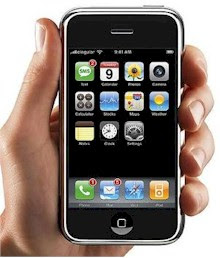
Despite its simple interface, with just four rows of colorful icons on a black background, the iPhone has too many features and functions to detail completely in this space. But here's a rundown of the key features, with pros and cons based on our testing.

Hardware: The iPhone is simply beautiful. It is thinner than the skinny Samsung BlackJack, yet almost its entire surface is covered by a huge, vivid 3.5-inch display. There's no physical keyboard, just a single button that takes you to the home screen. The phone is about as long as the Treo 700, the BlackBerry 8800 or the BlackJack, but it's slightly wider than the BlackJack or Treo, and heavier than the BlackBerry and BlackJack.

The display is made of a sturdy glass, not plastic, and while it did pick up smudges, it didn't acquire a single scratch, even though it was tossed into Walt's pocket or briefcase, or Katie's purse, without any protective case or holster. No scratches appeared on the rest of the body either.

There are only three buttons along the edges. On the top, there's one that puts the phone to sleep and wakes it up. And, on the left edge, there's a volume control and a mute switch.

One downside: Some accessories for iPods may not work properly on the iPhone. The headphone jack, which supports both stereo music and phone calls, is deeply recessed, so you may need an adapter for existing headphones. And, while the iPhone uses the standard iPod port on the bottom edge, it doesn't recognize all car adapters for playing music, only for charging. Apple is considering a software update to fix this.

Touch-screen interface: To go through long lists of emails, contacts, or songs, you just "flick" with your finger. To select items, you tap. To enlarge photos, you "pinch" them by placing two fingers on their corners and dragging them in or out. To zoom in on portions of Web pages, you double-tap with your fingers. You cannot use a stylus for any of this. In the Web browser and photo program, if you turn the phone from a vertical to a horizontal position, the image on the screen turns as well and resizes itself to fit.

In general, we found this interface, called "multi-touch," to be effective, practical and fun. But there's no overall search on the iPhone (except Web searching), and no quick way to move to the top or bottom of pages (except in the Web browser). The only aid is an alphabetical scale on the right in tiny type.

There's also no way to cut, copy, or paste text.

And the lack of dedicated hardware buttons for functions like phone, email and contacts means extra taps are needed to start using features. Also, if you are playing music while doing something else, the lack of hardware playback buttons forces you to return to the iPod program to stop the music or change a song.

Keyboard: The virtual keys are large and get larger as you touch them. Software tries to guess what you're typing, and fix errors. Overall, it works. But the error-correction system didn't seem as clever as the one on the BlackBerry, and you have to switch to a different keyboard view to insert a period or comma, which is annoying.

Web browsing: The iPhone is the first smart phone we've tested with a real, computer-grade Web browser, a version of Apple's Safari. It displays entire Web pages, in their real layouts, and allows you to zoom in quickly by either tapping or pinching with your finger. Multiple pages can be open at the same time, and you can conduct Google or Yahoo searches from a built-in search box.

Email: The iPhone can connect with most popular consumer email services, including Yahoo, Gmail, AOL, EarthLink and others. It can also handle corporate email using Microsoft's Exchange system, if your IT department cooperates by enabling a setting on the server.

BlackBerry email services can't be used on an iPhone, but Yahoo Mail supplies free BlackBerry-style "push" email to iPhone users. In our test, this worked fine.

Unlike most phone email software, the iPhone's shows a preview of each message, so you don't have to open it. And, if there is a photo attached, it shows the photo automatically, without requiring you to click on a link to see it. It can also receive and open Microsoft Word and Excel documents and Adobe PDF files. But it doesn't allow you to edit or save these files.

Memory: The $499 base model comes with four gigabytes of memory, and the $599 model has eight gigabytes. That's far more than on any other smart phone, but much less than on full-size iPods. Also, there's no slot for memory-expansion cards. Our test $599 model held 1,325 songs; a dozen videos (including a full-length movie); over 100 photos; and over 100 emails, including some attachments, and still had room left over.

Battery life: Like the iPod, but unlike most cellphones, the iPhone lacks a removable battery. So you can't carry a spare. But its battery life is excellent. In our tests, it got seven hours and 18 minutes of continuous talk time, while the Wi-Fi was on and email was constantly being fetched in the background. That's close to Apple's claim of a maximum of eight hours, and far exceeds the talk time claims of other smart phones, which usually top out at five and a half hours.

For continuous music playback, again with Wi-Fi on and email being fetched, we got over 22 hours, shy of Apple's claim of up to 24 hours, but still huge. For video playback, under the same conditions, we got just under Apple's claim of seven hours, enough to watch four average-length movies. And, for Web browsing and other Internet functions, including sending and receiving emails, viewing Google maps and YouTube videos, we got over nine hours, well above Apple's claim of up to six hours.

In real life, of course, you will do a mix of these things, so the best gauge might be that, in our two-week test, the iPhone generally lasted all day with a typical mix of tasks.

Phone calls: The phone interface is clean and simple, but takes more taps to reach than on many other smart phones, because there are no dedicated hardware phone buttons. You also cannot just start typing a name or number, but must scroll through a list of favorites, through your recent call list, or your entire contact list. You can also use a virtual keypad.

One great phone feature is called "visual voice mail." It shows you the names or at least the phone numbers of people who have left you voicemail, so you can quickly listen to those you want. It's also very easy to turn the speakerphone on and off, or to establish conference calls.

Voice call quality was good, but not great. In some places, especially in weak coverage areas, there was some muffling or garbling. But most calls were perfectly audible. The iPhone can use Bluetooth wireless headsets and it comes with wired iPod-style earbuds that include a microphone.

A downside -- there's no easy way to transfer phone numbers, via AT&T, directly from an existing phone. The iPhone is meant to sync with an address book (and calendar) on a PC.

Contacts and calendars: These are pretty straightforward and work well. The calendar lacks a week view, though a list view helps fill that gap. Contacts can be gathered into groups, but the groups can't be used as email distribution lists.

Syncing: The iPhone syncs with both Macs and Windows PCs using iTunes, which handles not only the transfer of music and video, but also photos, contacts, calendar items and browser bookmarks. In our tests, this worked well, even on a Windows Vista machine using the latest version of Outlook as the source for contacts and appointments.

iPod: The built-in iPod handles music and video perfectly, and has all the features of a regular iPod. But the interface is entirely new. The famed scroll wheel is gone, and instead finger taps and flicking move you through your collection and virtual controls appear on the screen. There's also a version of the "cover flow" interface which allows you to select music by flipping through album covers.

Other features: There are widgets, or small programs, for accessing weather, stock prices and Google Maps, which includes route directions, but no real-time navigation. Another widget allows you to stream videos from YouTube, and yet another serves as a notepad. There's a photo program that displays individual pictures or slideshows.

The only add-on software Apple is allowing will be Web-based programs that must be accessed through the on-board Web browser. The company says these can be made to look just like built-in programs, but the few we tried weren't impressive.

Missing features: The iPhone is missing some features common on some competitors. There's no instant messaging, only standard text messaging. While its two-megapixel camera took excellent pictures in our tests, it can't record video. Its otherwise excellent Web browser can't fully utilize some Web sites, because it doesn't yet support Adobe's Flash technology. Although the phone contains a complete iPod, you can't use your songs as ringtones. There aren't any games, nor is there any way to directly access Apple's iTunes Music Store.

Apple says it plans to add features to the phone over time, via free downloads, and hints that some of these holes may be filled.

Expectations for the iPhone have been so high that it can't possibly meet them all. It isn't for the average person who just wants a cheap, small phone for calling and texting. But, despite its network limitations, the iPhone is a whole new experience and a pleasure to use.

Tuesday, June 26, 2007

Keep your kids quiet. Backseat TV coming from Sirius

Sirius will offer mobile television service with a receiver supplied by Directed Electronics in the fall of this year, to sell for about $299 in stores, or built-into some Chrysler Corp. vehicles for $470.

According Sirius, the retail product will work with any existing car video system or radio. The unit includes a display module, a hideaway black-box receiver and two remote controls, including one with large buttons for kids in the rear seat and one for playing Sirius radio in the front seat. The service will cost $19.95 per month and will be sold as a package for standard Sirius radio plus Sirius video service.

If consumers already have a Sirius radio subscription, they will pay an additional $7.00 per month, but you have to have an audio subscription to have the video subscription. Sirius will offer three channels of programming for its TV service, which is aimed at kids, from Nickelodeon, Disney Channel and Cartoon Network.

On an OEM level, the service called Sirius Backseat TV will be offered starting in the 2008 model year through Chrysler, Jeep and Dodge vehicles at $470. It may be available through other car makers in the future. (info from TWICE)

Monday, June 25, 2007

Heading to L.L. Bean? Stop at Cindy's for the best fried clams on Earth

Freeport, Maine is best known as the home of L. L. Bean, and a growing number of outlet stores.

On a shopping trip in the summer of 2003, we decided to take a slightly slower drive back to our hotel in Portland, and instead of getting right on Interstate 295, we went south on Route 1, and made a wonderful discovery - Cindy's seafood stand.

The sign said CLOSED and we drove past, but one of the kids said she saw a light on, so I made a quick U-turn and pulled into the driveway.

I didn't know if business had been slow that day, or if owner Bob Pottle and his crew were just taking pity on famished clam fanatics; but they were extremely gracious, staying late to make us some magnificent munchies. The food was so good, we drove back for lunch the following day.

Cooking whole-belly clams is a delicate process. If they are undercooked, they can be really disgusting, with soggy dough falling off. If they are cooked too long, they become rocks or ashes.

Bob has perfected the art. His clams are crunchy on the outside, juicy on the inside, with the best batter I've ever tasted (also used on mushrooms and onion rings).

Clam chowder is heavenly. Lobsters, either whole or in chunks on a roll, are fresh and flavorful. Depending or market conditions, you might find a big bargain.

I got some neat stuff at L.L. Bean; but the next time I went to Freeport, it was for clams, mushrooms and onion rings, not fishing rods, moccasins and back packs; and I go back twice each summer.

Hours are 11 AM to 7 PM Sunday through Friday (closed on Saturday). The address is 174 Yarmouth Road (Route 1), just north of Exit 17 from Interstate 295. You can call 207-865-1635. When summer ends, the food stops flowing, and host Bob Pottle and family switch gears to sell Halloween and Christmas items.

The food stand has been open since 1980 and is named in honor of Bob's daughter. The signs don't mention the SUPERB fried clams and steamers, but it's not a secret anymore. Bob has very high standards. If he can't get perfect clams, he doesn't buy any. Bob is justifiably proud of his cooking and baking, and if he senses that you're a serious eater, he'll probably offer you samples of some of the items you haven't ordered.

Cindy's is more than a restaurant. It's also kind of a museum and amusement park. There's lots to keep you busy while your food is being prepared. You can get souvenir T-shirts, mugs and more, and pose for phunny photos...so you can leave with more than a smile and a full belly.

CLICK for more.

Thursday, June 21, 2007

Crystal-encrusted electronics


Those of you who are bored with traditional silver, black or white electronic gadgets, will be able to buy headphones and USB drives encrusted with Swarovski crystals later this summer.

The Active Crystals line from Philips includes ear buds, ear-hook style headphones and a pendant–style set of ear buds designed to be worn around the neck, all with Swarovski crystals. There are also four 1GB USB drives concealed in wearable lock- and heart-shaped crystal-encrusted cases.

The accessories are aimed at the gift market, with suggested retail prices expected to range from $79 to $179. They'll be carried in department stores, electronics chains and Swarovski stores beginning in August. Or, you can wait until November and get them at dollar stores, flea markets or Overstock.com.

Wednesday, June 20, 2007

Scoops are perfect for scooping salsa:
more dip with less drip

I love tortilla chips and salsa. Most chips are too big to dip into a salsa jar, and it can be a pain to have to use a spoon to scoop out the salsa and spread it on a chip, which will probably break apart in your hand and drip the salsa all over.

Back in 2001, Frito-Lay, maker of lots of terrific crunch foods, extended their Tostitos Tortilla Chips product line with Tostitos Scoops, which can hold a heaping teaspoon of salsa or other glop or goo with its unique bowl-shaped design.

Tostitos have been around since 1981, and the Frito folks say the Scoop is "the most significant innovation" in the history of the Tostitos brand. "Tostitos Scoops! is the ultimate dip lover's chip," according to Andrea Thomas, Frito-Lay Marketing Director. "The unique shape empowers chip-and-dip lovers to scoop up more dip with less drip."

Company research shows that nearly 70 percent of consumers eat tortilla chips with a dip or salsa.

Frito-Lay designed a proprietary "form and fry" technique to create Tostitos Scoops. The technique first shapes the masa (corn meal dough) into a bowl-shaped design and then quickly fries the Scoops.

Scoops can be scarfed down with salsa or dip, or can be filled with a topping and served as hors d'oeuvres. I've eaten them just about anything I can find in the fridge, including cold spaghetti sauce, hot baked beans, cocktail sauce, melted cheese, baked beans with melted cheese, onion dip, chopped clams, and chopped liver (not together). I've only found one thing that doesn't go well with Scoops: sauerkraut. My dog loves Scoops, too.

Frito-Lay goes back to 1932, and has been part of Pepsico since 1965. It sells $11 billion worth of snack foods each year, including Lay's and Ruffles potato chips, Doritos and Tostitos tortilla chips, and Cheetos. YUM!

Editor's Note: Frito-Lay spells the Scoops name with an exclamation mark (Scoops!). It's OK for a package, but I think it looks silly in the blog.

Editor's Tip: All kinds of tortilla chips will break in the bag, and by the time you get to the bottom, you're bound to find pieces that are too small to dip or spread -- but they're too good to waste. Put the small pieces in a bowl, smash them with a spoon, pour in some salsa, mix it up, and eat with a spoon -- or a SCOOP.

Monday, June 18, 2007

Slacker PC radio will work with no PC

Internet radio, which can draw on vast collections of music from around the world and customize playlists to personal tastes, has 29 million listeners a week, up from 20 million three years ago; while ratings for traditional radio broadcasters have been stagnant.

Even so, the nascent industry has yet to capture the biggest prize -- portability.

Some halfway solutions exist, such as music devices that allow people to stream Internet radio on speakers, or software that allows access to Internet radio from cellphones. Results can be unreliable, expensive and violate cellphone contracts.

Several companies are jockeying for position in mobile Internet radio, in a race that could rearrange the music broadcasting business.

Slacker, Inc. announced the creation of "Personal Radio," which enables consumers to customize their own radio stations and listen to them wherever they happen to be. The Slacker Personal Radio experience is available now in beta for PC streaming at www.slacker.com and later this year on Slacker Portable Radio Players via Wi-Fi and Slacker Satellite Car Kits.

Slacker has acquired rights from content owners, including Sony BMG, Universal Music Group and hundreds of independent labels, that allow truly portable personalized radio for the first time. The service offers Wi-Fi and satellite music distribution, as well as DJ intelligence embedded in portable players. Slacker customers can play highly personalized, continuously refreshed radio stations everywhere they go.

"Personalized radio is a great way to listen to the music you love without having to work at it," said Dennis Mudd, CEO of Slacker. "The only problem is that until now, personalized radio has been stuck on the PC. Slacker solves that problem. Now you can just kick back and listen."

Slacker Personal Radio has millions of songs with the breadth and depth increasing continuously. The extensive Slacker music library is organized into numerous professionally programmed genre and sub-genre stations and over 10,000 stations that are built around specific artists. Personalization options include adjusting your stations to play more popular vs. more eclectic music, newer vs. older, or even to play more tracks you tagged as favorites.

Other features include: log in from any PC or Mac to hear personalized stations in CD quality; playback through web player, jukebox software and portable devices; create stations by combining favorite artists; select favorite tracks/artists to play more often and ban other tracks/artists; click through album cover art, band profiles, reviews and artist photos; easily share stations with friends

For the first time, Slacker Personal Radio Players will enable music lovers to play personalized radio everywhere they go. The new devices include integrated Wi-Fi and an on-board Slacker DJ. The Slacker DJ combined with the new Slacker caching system guarantees personalized CD quality radio stations to be played everywhere, even when not in Wi-Fi range. Slacker customers get deep, personalized radio stations with optimized radio programming sequences, continuously refreshed and updated to include personalized new music.

Additional Slacker device features include: 4" full screen display featuring album art, reviews, artist photos, bios and visualizations; support for MP3, WMA and video as well as "saved" radio tracks; automatically save and refresh personalized stations via Wi-Fi, satellite or USB.

Slacker is currently in discussions to provide Slacker Personal Radio through a broader range of devices in the future.

In the second half of 2007, Slacker device owners in the US will have the option to purchase Slacker satellite car kits that update the Personal Radio Player with new content through a breakthrough satellite broadcast system. Slacker car-top antennas receive high-speed music feeds from satellites throughout the continental United States, while the integrated Slacker DJ ensures favorite stations stay current.

Slacker Basic Radio is advertising-funded and will remain free to use on Slacker software and portable Slacker Personal Radio Players, while Slacker Premium Radio will cost $7.50 per month. Slacker premium service offers: no advertising; unlimited skipping; ability to save radio tracks to library

Slacker Premium Radio was expected to be available by the end of June, and portables in early summer. The satellite car kit will be offered in the second half of 2007. (This is a preview, not a review.) (info from Slacker and The Wall Street Journal)

Friday, June 15, 2007

Stupid mistakes mar enjoyable book about Orange County Choppers family

Orange County Choppers: The Tale of the Teutuls is vital equipment for fans of the popular cable TV show, and the family and business that inspired it.

more later.

Thursday, June 14, 2007

Tester for phone, video, data wiring

If you're reading this blog, there's a good chance that you have a house with a growing collection of wiring for music, video, phone, computer and maybe security and remote control.

The more wiring you have, the more chance there is that something will stop working. Wires inside walls should be safe for decades, but cords and jacks that people touch, are bound to crap out.

If you're faced with a dead phone or a PC that can't connect to the Web, you can call for help, wait a few days, and maybe spend $150.

Or, you can spend $99 for your own tester and fix it in five minutes.

Within the last few days, I had to troubleshoot a dead bedroom phone, and a rack-mounted PC that couldn't reach the iTunes website.

The phone is on my wife's night table. She beats the crap out of phones. Every phone in the house that she uses, is missing parts.

I wanted to teach her a lesson, and was reluctant to fix the phone, On the other hand, if she can't use that phone, she uses MY den as HER phone booth, or grabs an expensive cordless phone that usually crashes onto the floor and spends a few days under the bed with our remote controls and lost socks.

So, I replaced the phone; and the new one still didn't work. I then removed the jack from the wall, assuming that wife tripped over the cord and the force damaged the pins inside the jack -- but the jack looked pristine.

I then connected one part of my handy Paladin ProNavigator tester to the bedroom jack, and the other part to the patch panel in my basement phone room, and quickly determined that my wiring was fine. What wasn't fine, however, was the patch cord from the patch panel to my phone system control unit. I replaced that cord, and restored communication, and had one less reason to yell at my wife.

I have a monster rack-mounted PC in my "movie room" that has a big collection of music files, some going back to the original Napster days. I wanted to install the latest version of iTunes, so I could load the music and TV shows from my iPod, but I could not get the PC to connect to the web.

I have two LAN jacks behind the rack that used to be live. I used the Paladin to confirm that the in-wall wiring was good, and my patch cords were good.

The only thing left that I could think of, was that the network card in the PC was no good. I thought some more, and remembered going through the same testing a few years ago and coming up with the same conclusion. It's a major PITA to pull the heavy Antec PC chassis out of the rack to replace the network card, so I had previously installed a USB-to-LAN adapter, but it had fallen out of the USB port and was lying in the abyss at the bottom of my rack.

I fished it out, plugged it in, and got reconnected with Steve Jobs so my tunes could start flowing.


This set includes a main unit and remote, plus two Cat5 RJ45 patch cords. You can test cables or in-wall wiring, and get test results at both ends.

One-button, simple testing (PASS/FAIL or fault find)
  • Traces wires with tone & remote lights)
  • Quick fault analysis on coax & data cables)
  • CAT-5, CAT-5e or CAT-6 (UTP/STP) cable testing
  • Detects Opens, Shorts, Crossed Wires & Split Pairs
  • Compact & lightweight, comfortable to hold)
  • Designed & manufactured in the USA
  • Test status lights at both ends (main unit & remote)
  • Uses standard 9-volt battery (included) with auto-off function to preserve battery life.
  • One-year warranty.


  • CLICK to order.

    Wednesday, June 13, 2007

    Bada-bing-bing-bing.
    Deliverance will be delivered in Hi-Def

    Warner Home Video made some high-definition disc lovers squeal with anticipation this week when it announced the release of the 35th Anniversary Deluxe Edition of the classic film “Deliverance” on standard DVD, Blu-ray and HD DVD.

    All three films will be available on September 18. The SD disc will have a suggested retail price of $19.97, while the HD DVD and Blu-ray discs will be priced at $28.99.

    Warner said the deluxe edition contains several special features, such as commentary by director John Boorman and an examination of one of the most controversial scenes in film history. The special features are included in all three formats.

    Widely acclaimed as a landmark film, Deliverance is noted for the memorable music scene near the beginning that sets the tone for what lies ahead: a trip into unknown and potentially dangerous territory.

    In the scene, set at a rural gas station, character Drew Ballinger (Ronny Cox) plays the instrumental Dueling Banjos on his guitar with a mentally retarded hillbilly named Lonnie (implied as being an inbred albino in the novel, portrayed by Billy Redden in the film). The boy eventually outplays Drew with his banjo. The song won the 1974 Grammy Award for Best Country Instrumental Performance.

    The film was selected by the New York Times as one of "The Best 1,000 Movies Ever Made," and viewers of Channel 4 in the United Kingdom voted it 45 in a list of The 100 Greatest Films.

    In the film based on a 1970 novel of the same name by James Dickey, four Atlanta men (played by Burt Reynolds, Jon Voight, Ned Beatty and Ronny Cox) decide to canoe down the fictional Cahulawassee River in the remote Georgia wilderness, before it is flooded over by the upcoming construction of a dam and lake. The trip turns into a fight for survival when local hillbillies attack two of the men.

    In a famous scene, Ed (Voight) is tied to a tree with his own belt and cut by one of the hillbillies' knives. Bobby (Beatty) is then forced to strip before being humiliated and then brutally raped by one hillbilly. Attention is then turned to Ed, and the other hillbilly said that Ed has "got a real purty mouth." Forced to defend themselves, the men kill two hillbillies while losing one of their own. (info from TWICE and Wikipedia)